
 Infant Journal
 Browse articles
Respiration: a guide to the latest equipment
When neonatal respiratory conditions present at birth or develop on the neonatal unit, it may be necessary to initiate ventilatory support to infants. Whether it is a preterm baby who requires intubating and ventilating, or an infant born at term who needs a short period of high flow oxygen therapy, there are numerous options for clinicians to choose from. In this issue of Infant, we look at the latest products designed to support newborn respiration.
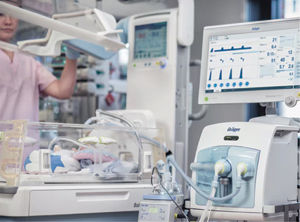
The Dräger Babylog VN600 comes with a new user interface and design which makes it easier and safer to operate. The neonatal ventilator supports lung and brain protective ventilation modes throughout the whole respiratory cycle. It supports smooth and seamless transition from O2 therapy to non-invasive ventilation to invasive ventilation and vice versa. Dräger Babylog ventilators can be easily integrated in a developmental care-friendly workplace.
The ventilators offer easy and efficient operation with a 15.6" screen. Dräger O2 therapy allows the caregiver to safeguard pressures at the patient’s interface by setting a maximum pressure to protect immature lungs from undesired high airway pressures. A display of the measured pressure at the interfaces supports an easy setting for the user.
They support high flow O2 therapy with HFNC with Dräger O2 therapy up to 30L/min for paediatric patients and up to 15L/min for neonates.
With the Babylog family, one breathing circuit system can be used for all therapy types. This allows for a quick and safe transition between non-invasive ventilation and high flow O2 therapy with HFNC. Less material usage and difference in systems may save time and reduce costs and disposal.
Features include:
- reliable pressure control and monitoring;
- demand flow principle to correct for leakages, thus stable pressure even in presence of leakages;
- trend data is available over the whole ventilation therapy;
- ventilation with only one breathing circuit is possible, which allows for kangaroo care;
- BabyFlow plus accessories for non-invasive respiratory support are available in different sizes providing comfort and optimum CPAP support to the infant.
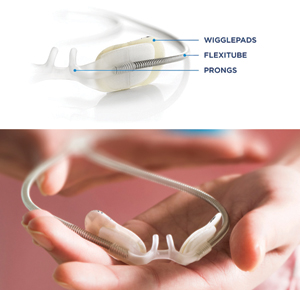
For years, Optiflow Junior by Fisher & Paykel has supported millions of babies worldwide. With Optiflow Junior no longer available, Optiflow Junior 2 takes the next step in nasal high flow therapy. Built with improvements shaped by customer feedback, the innovative interface addresses the key challenges that were reported: the nasal prongs staying in place and additional sizes.
Previously, the Optiflow Junior range offered only four sizes to cover a broad patient population, from neonates to children.
With Optiflow Junior 2, the sizing range at both ends of the spectrum has been expanded, catering to the smallest babies as well as larger-sized paediatric patients. There are six sizes to choose from: XS, S, M, L, XL and XXL, giving greater flexibility to deliver the right fit for every patient.
The non-sealing nasal interface provides:
- easy application and care with Wigglepads 2;
- minimised condensate and kinking with FlexiTube;
- soft, anatomically shaped prong design.
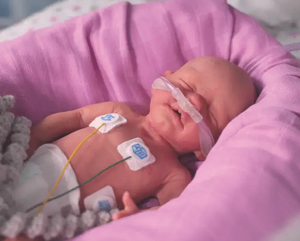
NeoFlow nasal cannula.
NeoFlow neonatal nasal high flow oxygen systems are designed to enable easy transition to and from nCPAP, bubble CPAP and invasive ventilation. The NeoFlow adjustable fixation pads are made with hypoallergenic adhesive tape and are available in three sizes:
- extra small for 3.8mm tubing;
- regular for 3.8mm tubing;
- regular for 5mm tubing.
The NeoFlow nasal cannula prongs include a positioning tab for easy alignment in
the nares. They are compatible with the NeoFlow bonnet, optionally reducing the need for fixation to the skin.
Should there be a need for escalation, NeoFlow transition kits allow a seamless transition to nCPAP. These can be used longer term if the infant must remain on nCPAP, or are a cost-effective alternative for a situation where nCPAP is required for a short period until the patient improves.
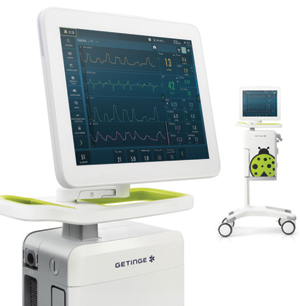
Whether for invasive or non-invasive ventilation, Servo-n by GETINGE has the ventilation modes necessary to deliver high-end neonatal or paediatric care, including neurally adjusted ventilatory assist (NAVA) therapy for personalised respiratory treatments. It gives valuable insights about patient-ventilator asynchrony, the presence or absence of spontaneous breaths, apnoea, patient effort, over- and under-assist, sedation and patient positioning.
With NAVA mode, it is possible to personalise support with every breath. When babies are on this mode, they tend to have lower pressure and tidal volumes. If babies need precise volume-targeted ventilation, pressure regulated volume control (PRVC) is available.
When the primary modes cannot ventilate the patient adequately there is built-in high frequency oscillation (HFOV) available. It can be reached with just a switch from a conventional mode. This allows the clinician to quickly start therapy without losing mean airway pressure. To achieve active exhalation and reduced work of breathing, it relies on the rapidly responding and synchronised inspiratory and expiratory valves.
 Free download PDF