

 Infant Journal
 Browse articles
Augmented reality-assisted videolaryngoscopy: a new vision for neonatologists?
This article explores neonatal intubation and why the skill can be challenging for trainees to master. Current practice with regards to laryngoscope choice is summarised. Finally, a study investigating novel emerging technology, which uses augmented reality to assist in neonatal videolaryngoscopic intubation, is described. Future applications of the device are imagined.
Jennifer ReekieST7 Neonatal Grid Trainee Neonatal Unit, Aberdeen Maternity Hospital, NHS Grampian
jenny_reekie@hotmail.com
Reekie J. Augmented reality-assisted videolaryngoscopy: a new vision for neonatologists. Infant 2024; 20(3): 99-101.
Background
Neonatal medicine is a specialty that has traditionally embraced technology and adopted modern innovations.1 With that in mind, sophisticated solutions to neonatal intubation are emerging, offering potential for modified techniques in the future.
Endotracheal intubation is a life-saving clinical intervention. Royal College of Paediatrics and Child Health (RCPCH) stipulates that competency in this skill must be demonstrated by neonatal trainees.2 However, neonatal intubation can be challenging, even in an infant born at term gestation. Paediatric trainee intubation success rates in neonates have been estimated to be as low as 24-53%.3,4 Reduced training opportunities due to increasing use of non-invasive ventilation and changing the clinical management of infants born through thick meconium have been cited as contributing factors.5
The neonatal patient group provides challenges, the combination of which are unique in clinical medicine: specific anatomical characteristics (relative micrognathia, small mouth and airway with large occiput, tongue and glottis); wet skin; fluid filled lungs at birth; tenfold differences in patient body weights (ranging from <500g to >5kg); and a transitioning cardiorespiratory system.1,6 Additionally, neonates have a tendency for rapid oxyhaemoglobin desaturation due to physiological factors such as higher oxygen consumption, low functional residual capacity and increased potential for airway collapse.7
Multiple intubation attempts have significant adverse associations in neonates,8 with prolonged or repeated intubation attempts exacerbating factors caused by immature physiology and ultimately leading to cardiorespiratory decompensation – factors that have detrimental effects on the developing brain.9 This further emphasises the need to prioritise training in neonatal intubation for future neonatologists.
As the specialty of neonatal medicine has a strong track record of embracing technological innovation,1 airway equipment in the future is likely to include solutions that foster high quality learning opportunities while maintaining patient safety. The most exciting innovation is the novel augmented reality (AR)-assisted videolaryngoscope for neonatal intubation.
Direct or indirect – scoping out current practice
Although in adult populations the use of videolaryngoscopes has been demonstrated to be more effective than direct laryngoscopy for tracheal intubation,10 the evidence base in neonatal medicine is less robust. Until recently, no official recommendation had been made by regulatory bodies with regards to laryngoscope choice in neonatal intubation. The British Association of Perinatal Medicine has now published a framework for practice which states:
“Use of a videolaryngoscope is strongly recommended both for supervising inexperienced intubators and in routine clinical practice.”11 There is variation in practice nationally, with current choice of instrument at individual and departmental discretion. European duo Bonfiglio and Greif12 recently published a narrative review exploring current neonatal intubation practice and reporting on recent trials. They concluded that videolaryngoscope-facilitated intubation with a standard blade in neonates should be strongly encouraged, in view of the available evidence that videolaryngoscopes achieve higher first pass intubation success rates and fewer intubation complications in neonates. As videolaryngoscopy is increasingly adopted in neonatal clinical practice, novel modifications to the device are likely to be similarly embraced.
The birth of AR-assisted videolaryngoscopy
AR displays virtual content, integrated into a user’s perception of the real-world physical environment.13 Applications of this emerging technology in medicine are still in the early stages and not yet widely adopted in clinical practice; however, examples can be seen in computer-assisted surgery, three-dimensional imaging, computed X-ray tomography and laparoscopy.14
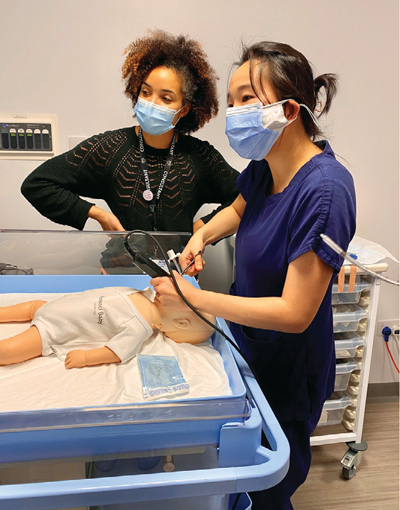
FIGURE 1 Simulation of staff attempting intubation using videolaryngoscopy.
The USA group led by Dias and colleagues14 has developed and studied an AR-assisted videolaryngoscope for neonatal intubation. Their device consists of a standard neonatal laryngoscope blade, with the addition of a small camera and adapter unit. A magnified video of the patient’s airway is projected into the intubator’s visual field via a pair of smart glasses. This affords the practitioner an enhanced view of the glottis, while maintaining direct line-of-sight vision of the larynx (giving simultaneous direct and indirect views). Additionally, the video stream can be viewed by trainers who provide live feedback. The use of a telestration feature enables instructors to make a digital drawing, instantaneously transmitting to the display on the glasses.
In their small pilot study15 investigating this technique, 45 inexperienced care providers with minimal experience in simulated neonatal intubation were divided into three equal groups and coached to complete five intubation attempts on a manikin using either direct laryngoscopy, indirect videolaryngoscopy or AR-assisted videolaryngoscopy. The research team found that in both the AR-assisted and videolaryngoscopy groups, where a magnified view of the airway was simultaneously viewed by a supervisor, there was significant improvement when compared with direct laryngoscopy. Intubation success rates doubled, multiple oesophageal intubation attempts were avoided and time to procedure completion was reduced. This adds to existing evidence demonstrating that a shared trainee and supervisor view in neonatal intubation can improve intubation success.16-18
Dias and team did describe a difference in the way subjects used the technology. Videolaryngoscope users took a dual approach, interchangeably directing their attention to a laptop screen, then converting to a direct view for intubation, whereas the AR adapted unit allowed for excellent direct line-of-sight visualisation of the airway.
A recent systematic review exploring user screen visualisation in videolaryngoscopy19 described the significant variation in screen viewing and gaze-switching between patient and screen during videolaryngoscopy. In AR videolaryngoscopy, the need to look back and forth between patient and screen would cease, with attention fixed on the patient.
Sample size was limited in the investigation of the novel AR-assisted videolaryngoscope device.15 Additionally, the pilot study was completed in a simulation environment with low generalisability. However, it can be inferred that sharing the airway view with an experienced trainer increases the potential for successful intubation. A UK-based team investigating intubation skills in neonatal trainees20 described the majority of unsuccessful neonatal intubations performed by inexperienced trainees being due to failure to recognise midline anatomical structure. Videolaryngoscopy enables supervisors to highlight important anatomical landmarks and provide live targeted feedback. Indeed, a recent systematic review21 described that videolaryngoscopy with real-time feedback was more effective for learning neonatal intubation than direct laryngoscopy. AR technology would develop this further, with the added benefits of a magnified view in the direct line of sight and telestration-enhanced coaching.
Another possible application for AR has been proposed: remote support.22 A distant specialist could share the view of the remote clinician by wearing AR glasses and provide instant feedback using telemedicine platforms. In the changing landscape of modern neonatology, with more extreme preterm infants delivered in or transferred to specialist units, perinatal network collaboration and regional trans-port teams become increasingly important in meeting the needs of these vulnerable patients. This technology would offer potential for specialists to provide remote, real-time support to local teams with less experience in neonatal intubation.
AR videolaryngoscopy development: first steps
With AR-assisted videolaryngoscopy in its infancy, there is a clear need for further research to demonstrate safety and efficacy. This technology has now outgrown the simulation setting and study is reportedly ongoing in the live neonatal patient group.15 In the future, AR-assisted videolaryngoscopy may yet prove to have the capability to enhance training experiences and importantly, improve patient outcomes.
Subjects in the AR-assisted video-laryngoscope pilot study demonstrated an ability to rapidly adapt to the technology.15 It is not yet clear whether experienced clinicians easily adjust their usual practice when utilising the device and this has been an area identified for further investigation.
Prospective widespread eventual adoption of the device has also been considered. The team led by Diaz sought to address accessibility concerns for its device through design choices that eliminate the need for a costly sterilisation process.15
The authors anticipate that the technology could be introduced easily, as neonatal departments could adapt laryngoscope blades already in use, through the simple addition of a small AR unit. These factors could aid the future adoption of this technology, particularly when considering low-resource settings.
Conclusion
In summary, in a specialty with decreasing opportunities for trainee clinicians to obtain and maintain intubation skills, robust training is a priority. The neonatal airway kit of the future must address the unique characteristics of neonatal patients and the need for clinicians to acquire and cultivate intubation skills. Investment in new and emerging technologies could support the neonatal community in optimising care, improving training and ultimately influencing neonatal outcomes.1
There is an increasingly convincing argument that neonatal videolaryngoscopy offers a superior educational experience compared to conventional laryngo-scopy.16-18,21 AR-assisted videolaryngoscopy has not yet been tested outside of the neonatal simulation environment, but has the potential to offer further advantages, such as line-of-sight display, telestration and remote capabilities.15
Although additional research is needed to explore the safety and anticipated benefits of this technology, the neonatal community appears likely to continue the tendency for embracing innovation.1 The neonatal airway kit of the future may well become an augmented reality.
 Free download PDF
Or read this article in our
Tablet/iPad edition
- Neonatal intubation can be challenging for new medical trainees.
- Novel technology using augmented reality integrated into videolaryngoscopy has been successful in the simulation setting.
- The technology could enhance training opportunities and improve patientexperience.
Also published in Infant: