
 Infant Journal
 Browse articles
Neonatal transport: a guide to the latest equipment
Whether an infant is being transported between the delivery unit and the neonatal intensive care unit, or between hospitals by road or air transfer, the safety implications for neonatal transportation are a necessary consideration for neonatal units. Normothermia needs to be maintained and any ventilation support needs to be continued without disruption. Suction may be needed to run continuously throughout transfers and observations require ongoing monitoring. Development of specialist, innovative equipment means that the safety and care of infants can be maintained throughout transportation.
Marie Hines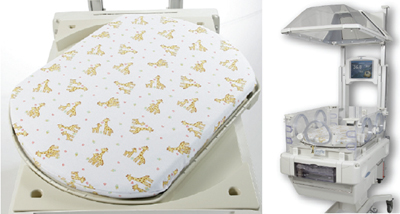
Above left: The Baby Susan mattress is pressure diffusing and bi-directional. Above: The Giraffe Omnibed Carestation.
GE HealthCare’s Giraffe OmniBed Carestation combines advanced technology with intuitive design to simplify and enhance clinical workflows. It gives caregivers the reliable neonatal solution they need to guide babies toward better health while ensuring parents can stay close and involved.
The full 360° Baby Susan rotating mattress enhances productivity by bringing the baby closer to caregivers, which encourages swaddling and kangaroo care, and helps optimise clinical procedures, improving their efforts to get it right the first time and reducing unnecessary baby stimulation.
A large colour display (10.4 inches) and touchscreen user interface helps caregivers streamline their workflow while monitoring and controlling the baby’s environment.
The screens can be customised for personalised, patient and family-friendly care environment while providing continued visual monitoring. They can be easily connected with hospital information systems and electronic healthcare records.
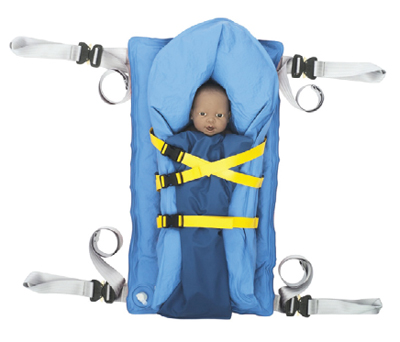
Meditech says its RedVac Newborn Transport System provides safe, stable and temperature-controlled transfer for pre-term and newborn babies up to six months old. Its integrated heating element maintains a precise 42°C, while dual vacuum chambers ensure correct spinal alignment and secure positioning during transport.
Meditech is the exclusive distributor for the RedVac Newborn Transport System, which is manufactured by Kohlbrat & Bunz in Austria. Engineered for use in ambulance and hospital environments, it ensures maximum safety, comfort and thermal stability throughout the entire transfer process. This system has been used in Europe for many years and has been tailored to suit the UK ambulance market.
Featuring an integrated heating element that maintains precise temperature, the system continuously monitors warmth via a built-in temperature sensor, ensuring optimal conditions for the infant. A fully charged internal battery provides up to two hours of operating time, with extended use possible via an external power bank or USB-C ambulance power connection.
The RedVac system includes two independent vacuum chambers:
- One acts as a rigid backboard, maintaining neutral spinal alignment from the moment the baby is placed inside.
- The second wraps securely around the infant, providing gentle support and stability during transport.
Additional wipe-clean safety straps and an optional blanket enhance security and infection control.
The RedVac Newborn Transport System quickly attaches to any ambulance stretcher and fits neatly into a compact carry bag for simple storage and rapid deployment.
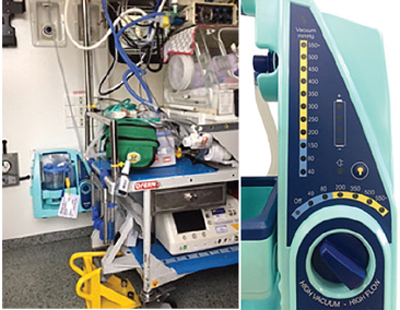
MGE Excellence’s neonatal version of the SAM e.p.s portable suction unit was developed following discussions with a neonatal transfer service team that was in the process of renewing its ambulance
fleet and could not find a suitable suction solution that specifically addressed the needs of the neonates/newborns being transported.
Once MGE understood what the limitations were with the existing standard suction units on the market, the company identified that its SAM e.p.s unit could be tailored to suit these needs and the SAM e.p.s Neonatal Unit was conceived, giving the very low levels of vacuum required for these delicate patients.
Providing a very low vacuum level setting of 40mmHg, the near silent unit not only solved a simple problem of suction being too noisy but also enabled procedures to be performed during transportation that the team was previously unable to carry out.
As the unit is portable and battery operated, it is suitable for any neonatal transport process, either externally between sites, fitted in ambulances with a powered mounting bracket, or internally within the hospital mounted on a neonatal transport trolley.
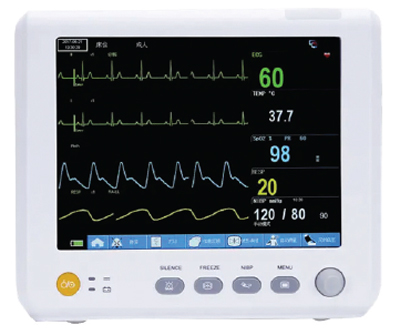
The Yonker M8 Patient Monitor is a transportable, multi-parameter bedside monitor designed for continuous monitoring of adult, paediatric and neonatal patients. Compact and versatile, it supports real-time tracking of key vitals and integrates wirelessly with central monitoring stations, making it suitable for use in wards, operating rooms, ICUs and during patient transfers.
A bright display presents all vital signs clearly in real time. The layout is intuitive, with waveform and numeric data displayed simultaneously. Monitored parameters standard with every unit are SpO2, pulse rate, non-invasive blood pressure, ECG and respiration, with dual temperature channels.
The M8 supports a range of optional modules and accessories, including: capnography (EtCO2), touch screen, recorder module, trolley or wall mounting system. It can wirelessly connect to a central monitoring system. One screen can display up to 16 monitors with eight waveforms each, and the system can monitor up to 64 beds in real time. Patient data can be viewed remotely, including during ambulance transfer or before hospital admission. The monitor stores up to 240 hours of dynamic trends, allowing clinicians to review patient progress directly on the unit.
Lightweight and portable, the M8 includes a carry handle and optional transport accessories.
 Free download PDF