
 Infant Journal
 Browse articles
Full Term February: raising awareness of babies born full term but sick
Chief Executive, Bliss
ask@bliss.org.uk
When Bethany’s baby boy Lennon was born at 39 weeks via an elective caesarean section, she did not expect that he would spend four days in the neonatal intensive care unit (NICU) before moving up to transitional care. She says: “We never met any other parents with full term babies in intensive care, and I felt like I didn’t belong there completely. The staff were amazing but I was never prepared for having a baby in neonatal care.”
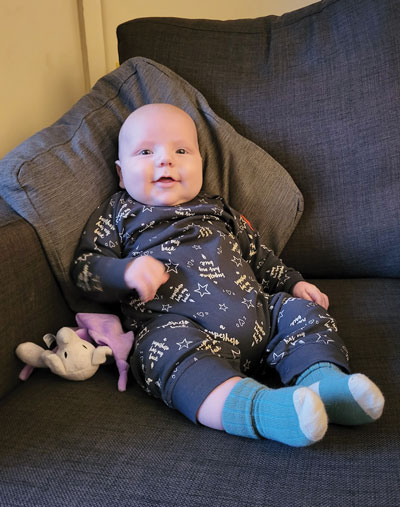
Lennon spent four days in the NICU following full-term birth.
Similarly, when Emma’s baby boy Marco was born at full term, she did not expect that he would end up needing six weeks of neonatal care. Marco had hyperinsulinism and developed other complications while in the NICU. Emma shares: “We drove every day to the hospital, meaning that we had to juggle childcare for my daughter. My partner spent his precious paternity leave at Marco’s cot side and had to have extra time off work.
“We were just about coping as we got into a routine but at times it was emotionally draining. I found it particularly helpful to go home a few hours earlier than my partner to have a break from the hospital environment. I would go home crying thinking I was useless and that Marco wouldn’t know who his mum was. I soon learnt that I shouldn’t be in competition with the nurses but take advantage of their expertise to make me into an even better mum for Marco.”
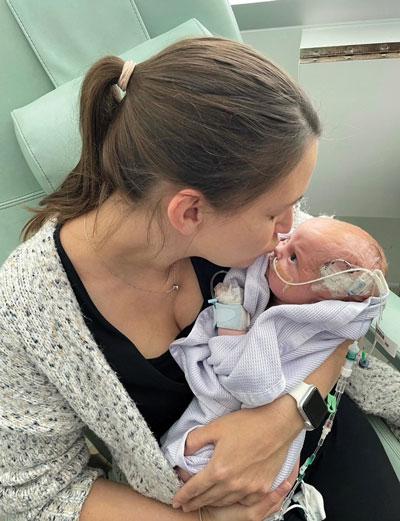
Emma and Marco.
Bethany and Emma’s experiences are common for many neonatal families. Every year, over 90,000 babies are cared for in neonatal units in the UK – that is around one in seven of all babies born in the UK. While there is reasonably good awareness of babies being born prematurely needing neonatal care – including high profile activity such as World Prematurity Day on 17 November – this can lead to a common misconception that all babies born needing neonatal care are premature. However, around 60% of babies admitted to neonatal care are born at full term but sick, and their families often tell us that they feel invisible in the popular perception of neonatal care, and they can also feel that they are ‘out of place’ in a neonatal unit.
While Bliss’ work to highlight the experiences of full-term families continues all year round, February marks a special time for us to give a voice to families who have had babies born at full term but sick, as we know how isolating the experience can sometimes be, how unexpected a full-term neonatal admission is for many families and how a neonatal stay of any length, whether a few days, weeks or months, can be deeply traumatic for babies and parents.
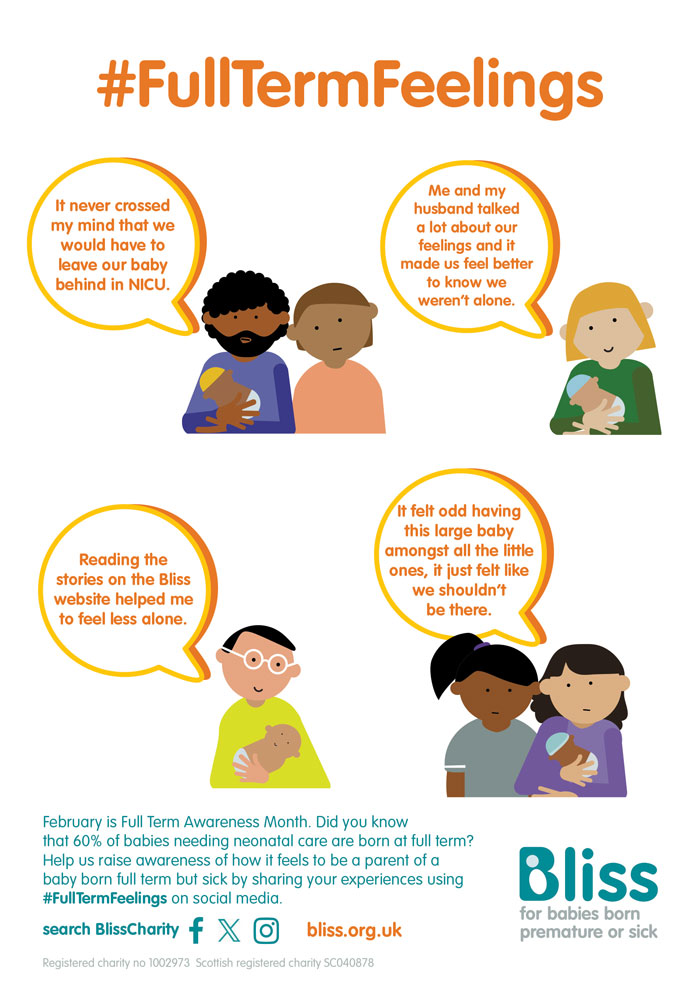
February is Full Term Awareness Month, a chance to raise awareness of babies born full term but sick.
There are a variety of reasons why full-term babies need to be cared for on a neonatal unit. According to the ATAIN (avoiding term admissions into neonatal units) programme,1 the five most common reasons are:
- respiratory conditions (about 25% of all term admissions)
infection (about 18%)
hypoglycaemia (almost 12%)
jaundice (around 6%)
asphyxia (hypoxic ischaemic encephalopathy, 2.5%).
There are also other conditions that babies may need to be admitted for, including congenital anomalies or genetic disorders.
Often, full-term parents tell Bliss that they felt out of place when their baby was in neonatal care because their baby was bigger than the others, or spent less time on the unit. Some have also described that they felt their experience was minimised if their baby was ‘only’ admitted for a few days. At Bliss, we are all too aware that no matter the length of stay, a neonatal experience can have a long-lasting impact on the whole family. Parents may never have imagined that their baby would need neonatal care and it can be difficult for them to talk to those who haven't been through the same unique experience.
Honey, parent to Sophie who was born at 38 weeks, had a traumatic birth experience that resulted in Sophie spending three weeks in the NICU. This experience meant that she faced a long-term impact on her mental health. Describing her feelings of the experience, Honey says: “Guilt is a feeling that has stayed with me. I grew this baby inside me and couldn’t deliver her safely. Then when Sophie was in the NICU, it felt like I was failing as a mum because I couldn’t hold, cuddle and kiss her or feed her how I wanted to feed her.” Regardless of whether their baby was born early or at term, any neonatal admission is a very scary time for parents whose babies are incredibly poorly and can have an impact on their mental health. For Honey, speaking to other parents in support groups really helped her and she now meets with a perinatal mental health group every month to raise awareness of the impact a traumatic birth and neonatal care can have.
Having a full-term baby in neonatal care also means that they might have different needs to those of premature babies. Emma reflected on Marco’s experience: “With Marco being full term and therefore older than the other babies on the unit, he needed more stimulation. The nurses put up a mobile on his cot and let us take in his bouncer, books and toys for him.”
It is so important that parents are partners in their baby’s care on the neonatal unit and should feel empowered to make decisions and advocate for their baby. For this to happen, healthcare professionals must understand the unique needs of each family, as well as the barriers to care – particularly for families of minority ethnicity or those from socioeconomically deprived backgrounds. The tailored and individualised care and support that a baby and its family receive on a unit is fundamental to tackling and overcoming these barriers. At Bliss, we strongly advocate that parents should be the primary caregivers for their babies while in neonatal care, and our work through the Bliss Baby Charter helps units to deliver this approach for every baby admitted, whether they are born early or at term.
Every single neonatal journey is different and all parents’ feelings are valid. Bliss offers a wealth of information and support for all neonatal parents on our website, as well as regular training events and resources for health professionals; most recently, we have developed comprehensive new information2 on supporting parents to be involved during their baby’s procedures on the neonatal unit, which is just as relevant for parents of term babies as it is for those of premature babies.
Term babies are admitted to neonatal care all year round, and Bliss supports their families every day. This Full Term February, in particular, we wanted full-term parents to know that they are not alone, and we encourage all units to support our ongoing campaign to raise awareness of their unique experiences, as well as the support available for every stage of their neonatal journey.
 Free download PDF
Or read this article in our
Tablet/iPad edition