
 Infant Journal
 Browse articles
Implementing ‘parent drop-ins’ at TMBU: scaling up family-integrated care
Beatrice Ramunno1
Neonatal Staff Nurse, b.ramunno@nhs.net
Heike Rabe2
Professor of Perinatal Medicine and Honorary Consultant Neonatologist
Jackie Knight2
Senior Lecturer in Medical Education
1Trevor Mann Baby Unit (TMBU), University Hospitals Sussex NHS Foundation Trust
2Brighton and Sussex Medical School
The family-integrated care model
Family-integrated care (FIC) is a model of care for neonatal units developed in Canada,1 which was inspired by the involvement of mothers in the mother-baby unit at Tallinn Children’s Hospital in Estonia.2
The FIC model is built on four pillars: staff education and support; parents’ education; the neonatal intensive care unit (NICU) environment, and psychosocial support.1 The model fosters the involvement of the family in partnership with the healthcare team, promotes informed decision-making and supports an ongoing collaboration between parents and staff.3
O’Brien et al demonstrated the positive outcomes emerging from the application of FIC in the NICU, among which include an increase in infants’ weight gain, increased rate of exclusive breastfeeding at discharge and decreased parental stress and anxiety.4 Subsequent findings suggested that FIC, by supporting greater parental presence in the NICU, impacts positively on an infant’s neurodevelopment and improves maternal wellbeing.5,6
The RISEinFAMILY study
In 2021, Moreno-Sanz et al adapted the FIC model to befit a level 3 NICU, caring for extremely premature neonates and patients with complex or surgical neonatal conditions.7 From this, the RISEinFAMILY study took shape as an international, multi-centre, cluster-controlled trial, which aims to demonstrate the superiority of the FIC model versus standard NICU care (https://riseinfamily.eu/en). The main objectives of the study are to adapt the model of care to a wider geographical and sociocultural diversity, and to investigate the proportion of high-risk infants receiving FIC achieving and maintaining adequate growth patterns during their stay in the NICU.

The RISEinFAMILY project (https://riseinfamily.eu/en) is an international network of organisations working at scaling up and implementing the FIC model in NICUs.
The Trevor Mann Baby Unit (TMBU) in Brighton and the Special Care Baby Unit (SCBU) in Haywards Heath form one of the seven sites involved in the RISEinFAMILY research. Together with the quality improvement initiative led by the Kent-Surrey-Sussex Network to standardise neonatal care, Brighton’s site is striving towards the goal of implementing FIC. To support families through their journey, TMBU and SCBU offer various facilities, including accommodation, a kitchen and a breastfeeding/expressing room within the NICU, free parking, as well as counselling available to parents.
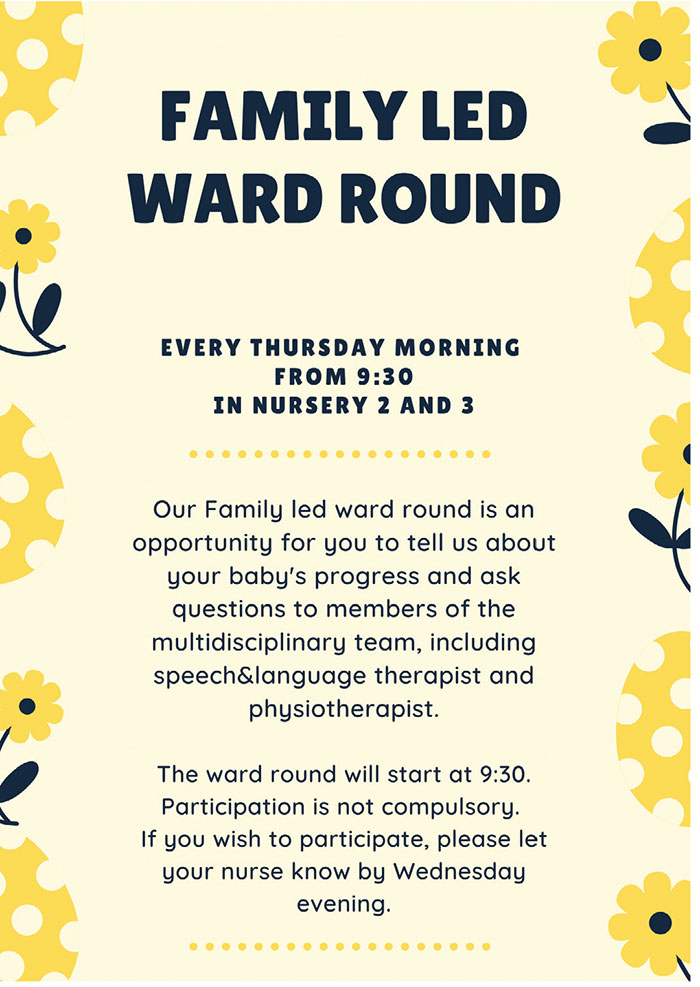
A poster encouraging parents to attend the family-led ward rounds.
Family-led ward rounds
From June 2021, the Trevor Mann Baby Unit implemented weekly family-led ward rounds, in which parents have the opportunity to meet the multidisciplinary team involved in their baby’s care, ask questions and work in partnership with the healthcare professionals. These have proved to be successful and parents have expressed positive feedback. For instance, a mother comments:
“I felt welcomed and involved when caring for my child. As a first-time mum, I have a lot to learn (…) but being part of this makes it easier. All the questions are answered and it teaches you what to do, especially for your little one’s development.”
Parent drop-in meetings
Taking inspiration from Moreno-Sanz et al’s development of workshop sessions to promote parental education,7 we implemented ‘parents drop-ins’ – informal weekly meetings to promote parents’ involvement in the NICU, as well as welcoming other members of their family. Firstly, we conducted a survey to identify parental wishes and needs, asking if they would be interested in educational sessions and which core topics relating to neonatal care they would like to see addressed. 80% of participants declared that they would attend educational sessions, being interested in:
- developmental care (positioning, skin-to-skin, mouth care, learning baby’s cues)
- feeding (breastfeeding and bottle feeding, weaning)
- parental wellbeing (mindfulness and relaxation)
- some specific subjects (eg breathing support, stoma care, eye problems).
Acknowledging the challenge faced by Moreno-Sanz et al of poor parental attendance,7 our team attempted to overcome the likelihood of the same issue, by implementing two changes. Firstly, the time of the drop-in was established to be the same every week – at lunch time on a Thursday, making this coincide with the day designated to the family-led ward rounds. In this way, parents would be available just after the ward rounds ended. To address parental concerns of being significantly physically apart from their children during the drop-in, it was decided to hold the sessions in the NICU family area, which is located on the same floor as the nurseries. Secondly, we offered a complimentary light lunch, funded by the Early Birth Association, to encourage attendance.
The neonatal team promoted the drop-in and the family-led ward rounds via the use of posters on the unit, as well as leaflets given out the day before. The sessions were informal, some of them would be run without a specific focus, while others would offer an educational aspect, which was advertised with posters prior to the session. The subjects addressed were:
- positioning and physiotherapy, with attendance of the unit physiotherapist
- medications questions and answers with the unit pharmacist
- parental support and wellbeing with an informal mindfulness session
- counselling with the unit counsellor.
Participants were able to leave feedback through a comment box or an online survey. Attendance varied throughout the weeks. The estimated median of participants was four per session, with an approximate number of 19 inpatients, this corresponds to an attendance rate of 20%.
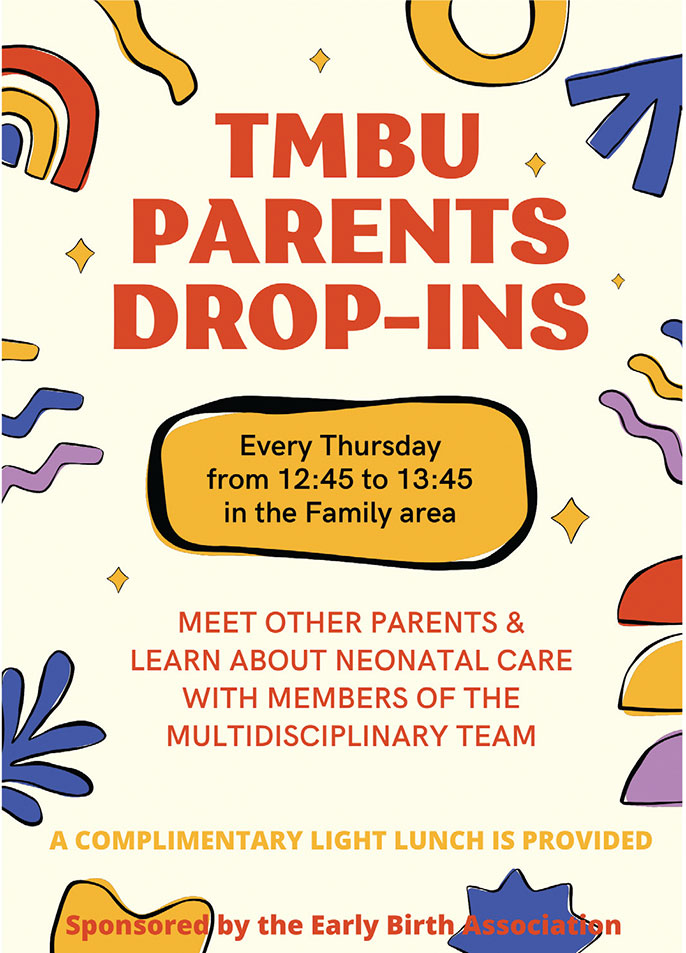
A poster for the TMBU parents’ drop-in meetings.
Despite the attendance being lower than the team had aimed for, the feedback received from the participants has been encouraging. Some of the comments received include:
“The drop-ins are a chance to run your thoughts with others and get encouraging comments and lots of positivity from staff and other parents. I find that I can relax in those few minutes, which is a luxury when alone and locked in my thoughts.”
“The drop-in was a lovely moment to think how far our baby has come.”
Similar to the findings of Moreno-Sanz et al,7 the preferred method for parental education has remained as cot-side teaching. The participants provided informal, positive feedback with regards to the topics addressed during the drop-in. However, it was found that the structure of the drop-in often shifted from the educational purpose to conversations between fellow parents.
This was an unexpected, but welcomed, outcome: long-stay parents forged strong relationships and provided guidance to newly admitted families, creating a peer support group of parents in the NICU.
Furthermore, the drop-ins have allowed the participating parents and carers to form a relationship with the healthcare professionals in a less formal, more relaxed environment. By engaging in conversations with the parents, we identified some gaps in the way we deliver care and were able to make changes to improve. For example, we found out how some parents were not aware of the facilities available to them during their NICU stay
(ie kitchen, accommodation day-passes) and so we improved our ‘welcome packs’ and encouraged staff to complete a checklist when welcoming parents on the unit as well as creating an online notice board (Padlet) containing useful information. We have now incorporated the staff checklist into our pre-existing parentcraft checklist, for example:
- parents have been shown around the unit ✔
- hand washing demonstrated. ✔
By fostering a sense of safety and belonging within the drop-ins, some parents felt able to speak openly about their feelings, sharing tears and laughter with fellow parents. A mother stated that since her baby had a desaturation episode during skin-to-skin care, she hadn’t been able to practise skin-to-skin again. Being able to talk about it in a calm environment, meant that our team could help her overcome this fear and support her during her journey.
In conclusion, the drop-ins have been an opportunity to improve parental engagement in the NICU and to increase parental awareness on neonatal care. Despite the attendance being variable, the feedback received from parents and other family members has been encouraging and the team is hopeful that the drop-ins will form a step towards the achievement of our goal of implementing FIC in our unit.
 Free download PDF
Or read this article in our
Tablet/iPad edition